
India's defence establishment is taking the new Chinese threat seriously, as also that posed by Pakistan's nuclear-tipped MRBMs -- like the Ghauri-2 and the Shaheen-2 -- which can strike targets 2300 kilometres away.
Barely a month after carrying out successful tests of Interceptor missiles, India is in talks with a leading American aerospace firm to apparently seek collaboration to develop a robust ballistic missile defence (BMD) system.
Pakistan on Friday test-fired the nuclear-capable, medium-range 'Ghauri' missile.
Though the ITR authorities were not immediately available for comment, defence sources said the sophisticated missile could not take off during the planned trial from the launch complex-III of the test range due to some "technical snag."

"We estimate that Pakistan now has a nuclear weapons stockpile of approximately 170 warheads. The US Defense Intelligence Agency projected in 1999 that Pakistan would have 60 to 80 warheads by 2020, but several new weapon systems have been fielded and developed since then, which leads us to a higher estimate," the Nuclear Notebook column published in the Bulletin of the Atomic Scientists on September 11 said.
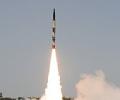
The surface-to-surface missile was test-fired from a mobile launcher at about 0830 hrs from launch pad-4 of the Integrated Test Range (ITR) at Wheeler Island, about 100 km from Balasore in Odisha, defence sources said.
In our euphoria over the successful Agni V test, we should not lose sight of the continuing gaps in tactical capabilities and the need to close them, writes B Raman
After carrying out major upgrades, India will test fire an advanced version of its indigenous Ballistic Missile Defence system in February allowing it to destroy enemy rockets at a much higher altitude.

The Prithvi-II missile has already been inducted by the armed forces and is handled by the army units attached to the strategic force command's special group.
India on Saturday successfully test-fired indigenously developed ballistic missiles 'Prithvi-II' and 'Dhanush' from different locations off the Orissa coast, adding more firepower to the armed forces.
India is developing a 5,000 km-range Agni ballistic missile, Defence Minister A K Antony said on Monday.
Pakistan on Saturday test fired two short-range ballistic missiles capable of carrying nuclear and conventional warheads and striking Indian cities, with Premier Yousuf Raza Gilani saying it was time for the world to recognise his country as an atomic power.The armed forces conducted 'training launches' of the Shaheen-I missile with a range of 650 km and the Ghaznavi missile with a range of 290 km at the conclusion of an annual field training exercise.
The underwater leg of the nuclear triad has always been regarded as the most survivable. Going by the January 27 test, the K-15 missile is well up to the task. Ajai Shukla reports

Pakistan is allegedly working on an offensive chemical and biological warfare program with the help of its 'all-weather friend' China.

India on Friday night successfully conducted maiden night test of its indigenously developed nuclear-capable Agni-I ballistic missile with strike range of 700 km from a test range off Odisha coast as part of a user trial by the Army.
India on Friday successfully test-fired the indigenously developed nuclear capable Agni-I ballistic missile, with a strike range of 700 km, as part of the Indian Army's user trial from a test range at Wheeler Island off Odisha coast.

India on Sunday successfully test-fired its medium-range nuclear-capable Agni-II missile with a strike range of more than 2,000 km from the Wheeler Island off Odisha coast as part of a user trial by the army.

India also advised its citizens to avoid all non-essential travel to Iran.

The missile, which is about nine metres in length and one metre in width, can carry conventional as well as nuclear warheads and has a range of 350 kilometres.
India on Thursday conducted the maiden test of its indigenously developed nuclear capable Agni V ballistic missile with a strike range of over 5,000 km, from the Wheeler Island off Odisha coast.
India "successfully" test-fired its nuclear-capable Agni-III ballistic missile with a range of more than 3,000 km from the Wheeler Island off the Orissa coast, on Sunday.
India is planning three more tests of the nuclear capable Agni-III missile with a range of 3000 km.

Low-level lightweight radars; very short-range air defence systems (launchers and missiles); remotely piloted aerial vehicles; loitering munitions, including vertical take-off and landing systems; different kinds of drones; bullet-proof vests; ballistic helmets; quick-reaction fighting vehicles -- heavy and medium; and night sights for rifles (aiming devices that are visible in low light).

The test, conducted at an undisclosed location, was witnessed by the Joint Chiefs of Staff Committee Chairman Gen Shamim Hyder Wyyne.

The Iranian missile attack on Israel appears to have been defeated and ineffective, United States President Joe Biden said, hours after Tehran fired nearly 200 missiles at Israel.
India will join the elite club of nations having ICBM with the Defence Research and Development Organisation planning to carry out the launch of over 5,000 km-range Agni-5 missile in April.

"The experimental launch of Agni-II missile experienced a trajectory deviation immediately after the lift off resulting in failure of the mission," a DRDO spokesman said in New Delhi.
India's missile defence system is set to get a big boost as it is developing capability to intercept enemy missiles fired from a distance of up to 5,000 km, in effect tackling any possible threat from countries such as China. The capability is being developed by DRDO as part of the Ballistic Missile Defence shield, whose first phase is ready for deployment possibly in Delhi
India's nuclear-capable, surface-to-surface Agni-II ballistic missile, with a strike range of 2,000 kms, was on Friday test-fired as part of user trial by the army from the Wheeler Island off Orissa coast.

Zelenskyy further said that the assault occurred overnight and into the morning, and involved a barrage of approximately 120 missiles and 90 drones, including Shaheds, Zircons, Iskanders, and Kinzhals.

The government has approved the construction of two indigenously designed nuclear attack submarines and is expected to ink contracts next month to procure 26 naval variant of Rafale jets and three Scorpene submarines, Navy Chief Admiral Dinesh Tripathi said on Monday.

Iranian state television on Wednesday claimed that at least 80 "American terrorists" were killed after Teheran launched 15 missiles on US targets in Iraq.
Nuclear-tipped missiles don't give security, says Praful Bidwai
Defence Research and Development Organisation Director General Vijay Kumar Saraswat on Friday said the Agni-V missile, which took 30 years to be developed, was the best such thing in the 21st century. Agni-V is an intercontinental ballistic missile developed by the DRDO. It is part of the Agni series of missiles, one of the missile systems under the original Integrated Guided Missile Development Programme.
According to the Washington Post, American military officials say the intercontinental ballistic missiles, known as Prompt Global Strike weapons, are a necessary new form of deterrence against terrorist networks and other adversaries.
Adding teeth to its nuclear deterrence, India on Tuesday successfully test-fired an advanced variant of nuclear-capable Agni-II ballistic missile with a strike range of 3,000 km from an island off Odisha coast.

Pakistan has announced the creation of a new Army Rocket Force equipped with advanced technology to strengthen its combat capabilities. The announcement was made by Prime Minister Shehbaz Sharif, who also commented on the recent military confrontation with India and expressed gratitude to various countries for their support.
The Defence Research and Development Organisation is all set to conduct a trial of the new indigenously developed quick reaction, short-range Prahaar missile on Thursday from the Integrated Test Range at Chandipur-on-sea.
A day after India tested the new missile from waters off its Vishakahpatnam coast, Pakistan Navy Chief Admiral Muhammad Afzal Tahir described the development as a 'very serious issue', as it was aimed at deploying nuclear weapons at sea.
